Swim Meet 101
Regular Season Swim Meets
During the summer season, those meets are usually held on Tuesday evenings and away meets are on Thursday evenings.
Meets begin at 6:00 pm and generally end between 8:00 and 9:00 pm. Swimmers will need to be at the pool by 4:45 to get ready for warm-ups, unless otherwise directed by the coaches. The pool opens to Sailfish swimmers and families at 4:15 on Home Swim Meet Days. The maximum number of events a swimmer can participate in during a dual meet is four (4).
Upon arrival at a meet, be sure to check in with the Swimmer Check-in Volunteer. This helps the coaches know that all team members have arrived at the pool.
What to Bring to the Swim Meet
- •plenty of towels
- •goggles (two pairs in case one breaks)
- •swim cap
- •healthy snacks and drinks (lots of water)
- •warm clothes to put on after events (very important on cooler or windy evenings)
- •marker for noting events on swimmer’s arm
- •fun activities for your swimmer to do between events
- •chairs (some pools do not have many chairs available for use during a meet)
- •blanket (or extra towel) for swimmer or family to sit on
- •sports umbrella for swimmers to sit under
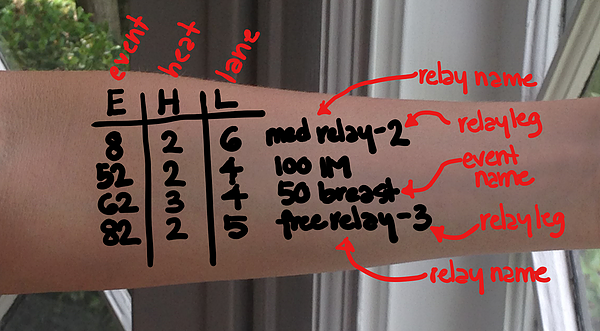
Once warm ups are complete, each swimmer should have the following information printed on their hand as shown below:
(E) Event number
(H) Heat number
(L) Lane number
Stroke
Permanent sharpie marker works best for this task.
How to decipher the swimming Heat Sheet
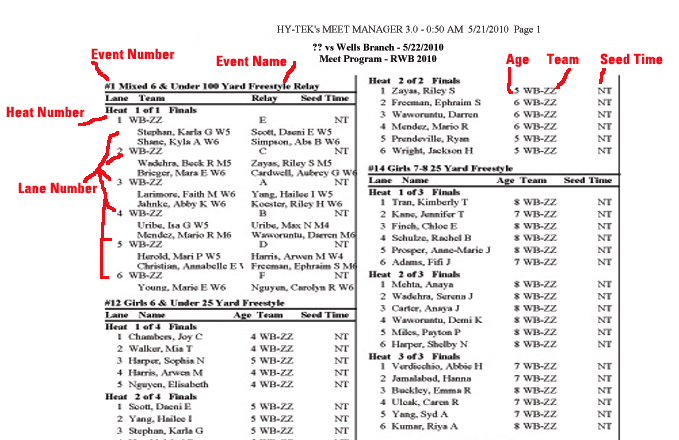

Regular season heat sheets are relatively simple, since there rarely are multiple heats. Each sheet contains the following information: Event number, event title, heat number, status of heat, lane number, swimmer’s name, swimmer’s age for season, swimmer’s team, and swimmer’s entry time. At the beginning of the season, each swimmer is designated an NT which stands for “No Time”. After they swim their first meet and earn an official time (not disqualified), a time will be shown in the last column. The seed time is based on their best time for the event, not necessarily the time from the previous meet.
Meet Events
Boys and girls generally swim each event separately.
The events for each stroke go from youngest to oldest. The girls in a given age group swim the even first, followed by the boys.
-
Medley Relay
- All age groups swim the Medley Relay, including 8 and under.
- It is a relay consisting of 4 swimmers.
- The Medley Relay has a specific stroke order: backstroke, breaststroke, butterfly, and freestyle. Since the younger children only swim one lap each, those swimmers swimming the breaststroke and freestyle portion of the relay must be at the opposite end of the pool, not the starting block end. Those swimmers will start in the water.
-
Butterfly
- Butterfly events follow the medley relay events.
-
Freestyle
- After the butterfly come the freestyle events.
-
Individual Medley
- Individual Medley, aka the 100 IM. We use abbreviations for everything! It’s like learning a new language.
- In the 100 IM, one swimmer swims one lap, one length of the pool, of each stroke in a specific order: butterfly, backstroke, breaststroke, and freestyle.
-
Backstroke
- Backstroke events follow the IM events.
-
Breaststroke
- Breaststroke events follow the backstroke events.
-
Freestyle Relay
- The freestyle relays are the last events of the meet.
- The children love relays and get a real sense of being part of a team by competing in them.
- Unforeseen circumstances may result in a child being placed in the relay at last minute, so never leave meets early!
- The relay team has 4 swimmers.
- Ages 10 and under swim a 100 meter relay, which means each swimmer swims one lap of freestyle.
- Ages 11-12 and up all swim a 200 meter relay, which means each swimmer swims two laps of freestyle.
Quick Reference
100 IM aka 100 Meter Individual Medley
- Order: Butterfly, Backstroke, Breaststroke, Freestyle
Medley Relay
- Order: Backstroke, Breaststroke, Butterfly, Freestyle
- All ages swim this event
- 10 & U ONLY: one lap of each stroke
- Breaststroker and Freestyler must be at opposite end of the pool!
Freestyle Relay
- For 10 & U: one lap of freestyle
- 2nd and 4th (aka “anchor”) child must be at the opposite end of the pool
Regular Season Swim Meet Order of Events COSA
NSSL Swim Championships
Championships are usually the 3rd Monday and Tuesday in July and will take place at various league pools including Springdale in 2026
Per the league rules, in order to be eligible to swim in the championship meet, swimmers must swim 2 regular season meets. The coaches will enter swimmers into events based on the times they achieved during regular season meets.
The top 16 swimmers, based on their preliminary event times, will return to swim in the finals sessions. Swimmers with the top 8 preliminary times swim in the finals heat Swimmers in the 9th through 16th spots swim in the consolation heat. In addition to the top 16 preliminary swimmers, the 17th and 18th place swimmers from the preliminaries will return for the final session as alternates, in case any of the finalist swimmers do not return for their event.
Two Day Championships at One Location
Swimming champions can be an all day event if the swimmer qualifies for finals or swims individual events and is part of a relay team. On both days, preliminary swimming events are held in the morning, with finals and relays held in the evenings. The events are divided up as follows, unless the hosting pool decides to follow the two day format below:
Monday Morning Preliminaries:
Monday Evening:
Tuesday Afternoon/Evening Finals
Swim Championship Additional Information
Championship tee shirts and other swim apparel will be available to purchase at the meet. In addition, heat sheets are available to purchase for each session (morning and evening) of the meet.
The team will be assigned a designated area for the swimmers to gather during the meet. Parents should be prepared to bring their own chairs to championships for use in the tent area. Bleachers are erected near the pool for spectators during events.
Helpful swimming Terms
- •Beep, Whistle, Starting Pistol: This may be all that is heard for the swimmer to start racing the event. He/she will hear the announcer state, “Swimmers, take your mark.” Then the swimmer will hear “one of the starting signals (Beep, Whistle, or a Starting Pistol).” The swimmer should immediately begin racing. If there has been a false start, the swimmer will hear a continuous beeping or whistle sound or the starting pistol one additional time during the race. He/she should stop swimming and return to the starting block.
- •Disqualification (DQ’d): A swimmer may be disqualified if they are not executing the stroke according to USA Swimming rules, if they dive in early, perform an incorrect flip turn or any number of other events. Although this can be upsetting to a child, “DQs” are very common and should be regarded as part of the learning process.
- •Dual Meet: Two teams compete at one location
- •Event: The race in which a swimmer will participate
- •False Start: Leaving the blocks before the sound of the starter's signal
- •Finish: Finishing a race often relies on split-second judgment. A decision to start a new arm stroke or lengthen the current one, may need to be made. In breaststroke and butterfly, both hands should touch the wall together; in freestyle and backstroke you can make the touch with one hand.
- •Heat: Race within a single event
- •Heat Sheet: A listing of all swimmers by heat and lane assignments at a meet, seeding swimmers according to times submitted.
- •Individual Medley: This is when a swimmer swims four different strokes in one race. The order is butterfly, backstroke, breaststroke, and then freestyle. Special turns are used because swimmers need to change from one stroke to another.
- •Relays: In relays, the swimmer is one of a team of 4 people each swimming an equal distance. There are 2 relays, the freestyle and the medley.
- •Scratch : When a swimmer, scheduled for an event, is removed by the coach prior to participating.
- •Seed: The placement within an event according to individual time
- •Seed Times: Time used to enter a swimmer in a meet. This determines a swimmer's heat and lane assignment
- •Starter: Official responsible for the start of each heat and for calling swimmers to the blocks.
- •Starting Block: Starting blocks are normally used to start an event where swimmers dive into the water. A swimmer may not take any stroke until he/she breaks the surface of the water. If a swimmer is not yet comfortable using the starting block, he/she may choose to start in the water or dive from the side of the pool. Backstroke is the only stroke where you have to start in the water.
- •Stroke/Turn Judge: The official that determines the legality of a swimmer's stroke or his/her turns
THE STROKES
Breaststroke
This stroke must be done on the stomach with some part of the head surfacing during each stroke sequence, except on starts and turns when one underwater pull and kick are allowed, in that order. The kick must be a squeezing action with no downward thrust of the legs, all on the same horizontal plane, recovering forward from the chest. The swimmer must touch the wall with both hands simultaneously at all turns and the finish.
Backstroke
Swimmers must remain on their backs until they touch the wall for a turn or finish. Any means of stroke or kick is allowed. The pennants hanging across the pool are situated to prepare the swimmer for the approaching wall.
Butterfly
The leg kick(s) must be a downward thrust, which is simultaneous action. The arm pull must be simultaneous and the arms must recover forward over the top of the water only. Both hands must touch the wall simultaneously at all turns and the finish.
Freestyle
"Free" means any stroke imaginable, but most swimmers choose the crawl, the fastest of the strokes. Any part of the body may touch the wall at turns and the finish. This is the first stroke emphasized and virtually all new swimmers will compete in freestyle events.
Eating Healthy Snacks and Meals Before and During Meet Days
Eating healthy gives our swimmers and divers the best recovery through out the summer, with daily workouts, multiple meets during the week, and dealing with the summer heat that each swimmer/diver needs to replace the energy used.
Remember that during the swim/dive meet drinking plenty of fluids (mostly water) and eating small amounts of carbohydrate-rich foods low-fat snacks (fresh fruit, whole grain crackers, pretzels, bagels, rice cakes, fruit bars, smoothies, and nonfat yogurt) are the key for replenishing the body's fuel source. You do want to avoid anything that has too much fat, fiber, or protein as these nutrients slow down digestion (cookies, candy bars, and potato chips).
The following is a list of some suggestions for great snacks after practice and during the meets.
- Bagels
- Chili in a cup
- Dry Cereal Fruit
- Fruit Juices (Diluted)
- Fruit Smoothies
- Low-fat Crackers
- Low-fat Muffins
- Water
- Oatmeal in a cup
- Soy Nuts
- Pretzels
- Sandwiches of turkey or other low-fat meat
- Soups in cups
- Sports Drinks
- Trail Mix
- Vegetables
- Jerky
- Yogurt
- Granola bars
Hazardous Weather Policy for Home Swim Meets
In the case of hazardous weather affecting the area during a home swim meet the following rules will apply:
- There will be a 30 minute delay for any thunder or lightning in the area. Every time thunder or lightning occurs the 30 minute clock restarts.
- Swimmers and families will be asked to clear the pool deck during hazardous weather. The Rec center gym will be opened up for us.